



The 2,500-Year-Old Greek Resin That's Quietly Becoming the Jawline Secret of NFL Players and Fighters
I spent three weeks looking into why elite athletes keep chewing this obscure tree resin from a single Greek island. The answer surprised me — and so did what it did to my jawline.
An increasing number of professional athletes are turning to a traditional Greek chewing resin for an unexpected reason: facial structure.
The first time a professional fighter told me he chewed tree resin before training, I thought it was a joke. The second time — from an NFL defensive back on a completely separate conversation — I started paying attention. By the fourth or fifth mention, from trainers and nutritionists who work with some of the highest-performing athletes in the country, I realized something strange was happening under the surface of men's health that almost no one was writing about.
The substance they kept referring to has a name most Americans have never heard: mastiha. It's a natural resin harvested from a specific tree that grows on exactly one island in the world — the southern half of Chios, a small Greek island in the Aegean Sea. The tree, Pistacia lentiscus var. Chia, has been cultivated there for over 2,500 years. The Greeks have been chewing its resin since before Plato was born.
What I didn't expect — and what took weeks of reading to understand — was that the reason it's showing up in NFL locker rooms and fight camps has less to do with its ancient medicinal reputation, and more to do with something far more modern: facial aesthetics, jawline definition, and what one researcher called "the most underrated facial training tool in men's wellness."
The Jawline Question No One Was Asking
If you've spent any time on the parts of the internet where men talk about their own appearance, you've probably noticed a shift. Over the last few years, jawline definition has moved from a niche obsession to a mainstream aesthetic concern — the way abs did in the 90s, or arms did in the 2000s. Search data confirms it. Searches for "jawline exercises," "mewing," and "facial symmetry" have climbed every year since 2019.
The underlying reason is simple, if uncomfortable to admit. A 2019 facial attractiveness study published in Evolution and Human Behavior found that jawline definition was one of the strongest single predictors of how attractive and confident men were rated — ahead of symmetry, skin quality, and several other variables that researchers expected to dominate. Put plainly: a well-defined jawline changes how you're perceived in a room before you open your mouth.
The problem is that most of the "jaw training" tools that have flooded the market are, by any honest measure, either useless or actively dangerous. Silicon chewing balls damage enamel. Plastic trainers create uneven bite pressure. Most people who buy them use them twice and throw them in a drawer. What athletes kept telling me they used instead was something far simpler: a small, hard lump of natural resin that takes ten minutes of serious chewing to soften.
Taylor Rapp, NFL safety — one of a growing roster of athletes using Chios mastiha as part of daily training.
"It's the closest thing I've found to a gym for your face. You chew for ten minutes, your jaw is sore the next day, and a month in, the difference is visible." — Taylor Rapp, NFL safety
What Makes Chios Mastiha Different
The first thing that becomes clear when you actually research mastiha is that it's not gum in any meaningful sense. Regular chewing gum is a synthetic polymer designed to soften within seconds — essentially a vehicle for flavor. Mastiha is a raw tree resin that enters the mouth as a hard, almost chalky crystal. It takes ten to fifteen minutes of continuous, forceful chewing before it begins to soften into something malleable.
That's not a design flaw. That's the entire point. The resistance is roughly ten times higher than commercial gum. The jaw muscles responsible for facial structure — primarily the masseter, which runs from cheekbone to jaw angle — respond to this kind of sustained resistance load the same way a bicep responds to curls. Under load, over time, they hypertrophy. They get bigger. And a larger masseter produces the sharper, more defined jaw angle that modern aesthetics has decided is a marker of male attractiveness.
Beyond the mechanical effect, the resin itself has a remarkable clinical résumé that has largely stayed buried inside European and Asian scientific journals. The Chios mastiha I kept finding referenced was the specific PDO-protected variety — the same grade that the European Medicines Agency approved as a traditional herbal medicine in 2015, that the Korean FDA recognizes as functional food, and that UNESCO inscribed on its list of Intangible Cultural Heritage in 2014. Not the commercial gum. The real thing.
- 9% reduction in total cholesterol and 12% reduction in LDL (CHIOS-MASTIHA clinical trial)
- EU Protected Designation of Origin — only resin from southern Chios can legally be called mastiha
- European Medicines Agency approval as traditional herbal medicine
- UNESCO Intangible Cultural Heritage inscription (2014)
- Korean KFDA recognition as functional food
- Documented in the Ayurvedic Pharmacopoeia for oral and digestive applications
The Side Effects No One Warned Me About
What the athletes I spoke with mentioned almost as an afterthought — but that became obvious after a few weeks of my own use — is that the resin doesn't just reshape the jaw. It does something to the mouth itself. Chios mastiha has documented antimicrobial properties, and multiple studies have shown it actively kills Streptococcus mutans, the primary bacteria responsible for cavities and bad breath. Within a week of regular chewing, my dentist noticed the difference before I mentioned anything.
This is not a small detail. Most jaw-training products create the opposite effect — they trap bacteria, erode enamel, or irritate the gums. Mastiha does the inverse. Whiter teeth, healthier gums, and genuinely better breath are not marketing claims on the box. They're the second-order consequences of chewing an antimicrobial resin for ten minutes a day.
Marco Beltrán, UFC fighter — part of a growing group of combat athletes who use mastiha daily.
Why This Is Only Now Reaching the U.S.
The simplest reason authentic Chios mastiha hasn't shown up in American supplement aisles is supply. The entire global annual production of PDO-certified mastiha is about 150 metric tons — harvested by hand, from roughly 5,000 families on the island, using techniques that haven't meaningfully changed since antiquity. It's not a category any major American supplement company can enter at scale, because there simply isn't enough of it to supply one.
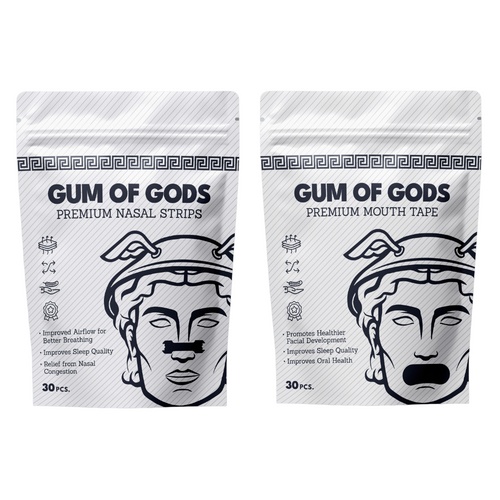
What has started to change that is a handful of small, direct-sourcing operations — one of which is a brand called Gum of Gods. They source their mastiha directly from Chios producers, import the raw resin, and sell it to Americans who, in my experience, fall into roughly three groups: men who figured out the jawline connection on men's-health forums, people dealing with specific digestive conditions for whom mastiha has real clinical backing, and performance athletes who just want the edge.
The authentic PDO-certified resin from Chios, imported directly by Gum of Gods.
I tried their product for three weeks as part of this reporting. The texture takes some adjustment — the first time you chew it, you'll understand why it's called a jaw workout. By the end of the first week, my jaw was sore in the same way a new lifter's shoulders are sore after their first push day. By the end of the third, I could see the difference in the mirror, and so could two people who had no idea I was writing this piece.
Gum of Gods offers what they call the Arsenal of Gods — a three-month supply of the resin in a rotating flavor system (Classic, Premium, Peppermint, and their newest Cherry variant, which they market as specifically optimized for jawline development). The three-month commitment matters, because the jaw changes they claim don't happen in two weeks. They happen in the 60–90 day window, which is also the length of their money-back guarantee.
The Arsenal of Gods — 3-Month Jawline Protocol
A full 90 days of authentic Chios mastiha. Long enough to see the difference — and covered by a 90-day money-back guarantee if you don't.
What to Expect If You Try It
A few things worth knowing before you order. First, the first few sessions are genuinely uncomfortable. The resin is hard, it sticks to teeth for the first minute or two before the temperature of your mouth softens it, and your jaw will be sore the next day. This is working as intended. Second, the effect is cumulative. Athletes I spoke with described noticeable jaw changes within 3–4 weeks of consistent use, with the most significant changes appearing around the 60–90 day mark. The 90-day guarantee exists because that's roughly how long the company needs to deliver on what it claims.
Third, and this surprised me: the taste is not what you expect. People who've heard about mastiha often imagine something resinous or piney. It's not. It has a clean, slightly sweet, almost cedar-floral character that grows on you quickly. Several European desserts and liqueurs are flavored with it for exactly that reason.
After finishing this reporting, I kept using the product. That's the most honest endorsement I can give a piece like this. The combination of a genuinely defined jawline, cleaner teeth, and the side benefits I didn't go looking for made it one of the few things I've reported on that quietly ended up in my permanent routine.
Start the 90-Day Jawline Protocol
The three-month supply is the only window long enough to see what it actually does. If it doesn't work, you get every dollar back.
See Availability