



A small, hard lump of natural resin from a single Greek island has quietly become one of the most-recommended health products in the men's wellness world — and almost no one I know has ever heard of it. After three weeks of chewing it daily as part of this reporting, I understand why the recommendations are spreading. I also understand why the Greeks have been doing it for 2,500 years.
The substance is called mastiha. It's a tree resin harvested from Pistacia lentiscus var. Chia — a species that grows commercially on exactly one island in the world: the southern half of Chios, in the Aegean Sea. The Greeks have chewed it since before Plato. The European Medicines Agency approved it as a traditional herbal medicine in 2015. The Korean FDA recognizes it as a functional food. UNESCO inscribed it as Intangible Cultural Heritage in 2014.
It's also showing up, increasingly, in the daily kits of professional athletes — and not for any of the reasons you'd guess if you read its medicinal résumé first. The reason it's reaching the U.S. market right now is simpler, more modern, and more visually obvious: it changes your face.
The Masseter Question
If you've spent any amount of time on the parts of the internet where men talk about their own appearance, you've probably noticed a pattern. Over the last several years, jawline definition has moved from a niche obsession to a mainstream aesthetic concern — the way visible abs did in the 90s, or sculpted arms did in the 2000s. Search data backs it up. Searches for "jawline exercises," "mewing," and "facial symmetry" have climbed every year since 2019.
The biological reason is straightforward, even if uncomfortable to discuss. The masseter — the muscle that runs from your cheekbone to the angle of your jaw — is the most visible facial muscle on the male face. It responds to mechanical resistance the same way any other muscle does. Load it, recover it, repeat. It hypertrophies. The visible result is the sharper, more defined jaw angle that modern aesthetics has decided is a marker of male attractiveness.
The problem is that almost every "jaw training" tool currently on the market is, by any honest measure, either useless or actively harmful. Silicon chewing balls damage enamel. Plastic bite trainers create asymmetric pressure. Most people who buy them use them three or four times and leave them in a drawer. What kept coming up in the conversations I had with trainers and athletes was something far simpler: a small, hard lump of natural tree resin that takes ten to fifteen minutes of forceful chewing to soften.
The first time I put a piece in my mouth, I understood why. Commercial chewing gum is a synthetic polymer engineered to soften within seconds — it's a flavor delivery system, not a workout. Mastiha is a raw resin that enters the mouth as a hard, almost crystalline lump and stays that way for the first ten minutes of chewing. The resistance is roughly ten times higher than regular gum. Within five minutes of chewing, my jaw was fatigued. Within ten, I was actively counting down to be done. That fatigue, I would learn, was the masseter doing the work it almost never gets to do anywhere else in modern life.
"It's the first thing in my training kit that doesn't go to my arms or legs. You feel it the next morning. By month two, you can see it."
What Actually Makes It 10× Harder
Beyond the mechanical effect, the resin itself has a clinical résumé that I had genuinely not expected and that has largely stayed buried in European, Korean, and Japanese scientific journals. The specific variety I kept finding referenced was the PDO-protected mastiha from Chios — the same grade that the EMA recognizes, the same grade that UNESCO inscribed, the same grade that has been documented in clinical trials going back several decades. Not commercial gum. Not extract capsules. The raw, chewable resin.
What the literature shows is that mastiha is rich in a class of compounds called masticadienonic acid derivatives, alongside a broad spectrum of natural terpenes, polyphenols, and antioxidants. These compounds have been studied for documented effects on the oral microbiome, the digestive tract, and cardiovascular markers. The CHIOS-MASTIHA clinical trial, for example, documented a 9% reduction in total cholesterol and a 12% reduction in LDL among regular users over an extended period.
None of this is fringe. The compounds and their documented effects are well-characterized in peer-reviewed literature. What's strange is how few Americans have ever encountered the product at all.
- 9% reduction in total cholesterol and 12% reduction in LDL — CHIOS-MASTIHA clinical trial
- EU Protected Designation of Origin — only resin from southern Chios can legally be called mastiha
- European Medicines Agency recognized as a traditional herbal medicine (2015)
- UNESCO Intangible Cultural Heritage inscription (2014)
- Korean KFDA recognition as functional food
- Documented in the Ayurvedic Pharmacopoeia for oral and digestive applications
- 100+ peer-reviewed studies on antimicrobial, digestive, and metabolic effects
The Side Benefits I Didn't Expect
What the trainers and athletes I'd spoken to had mentioned almost as an afterthought — but what became obvious within two weeks of chewing it daily — is that the resin doesn't just train the jaw. It does several other things at the same time, and most of them are pleasant surprises.
The teeth. Within seven days, my teeth felt visibly cleaner. By the end of the second week, I could feel the difference with my tongue. The mastiha resin has documented antimicrobial properties that have been studied specifically against Streptococcus mutans, the primary bacteria associated with cavities and bad breath. My dentist, who had no idea I was writing this piece, asked me at a routine cleaning what I'd changed.
The digestion. Mastiha has been used as a traditional remedy for indigestion, heartburn, and bloating for as long as it's been chewed. The European Medicines Agency's 2015 monograph specifically recognized it for digestive use. I wasn't expecting a noticeable effect — I don't have ongoing digestive issues. But within a week, the low-grade after-meal heaviness I'd quietly accepted as normal had quietly disappeared. I noticed it because it was no longer there.
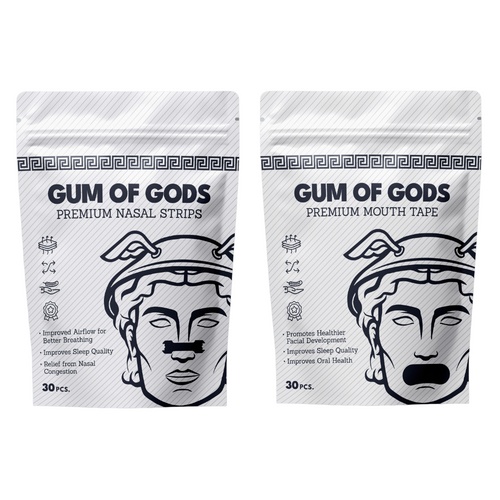
The breathing and sleep. This was the most unexpected. The Gum of Gods bundle I was using ships with mouth tape and nasal strips alongside the resin, which I'd initially treated as throw-ins. Two nights of taped sleep later, my Oura ring's sleep score had jumped meaningfully — and stayed there. Forced nasal breathing during sleep, which I'd read about but never tried, turns out to do exactly what the literature claims: deeper sleep, less morning puffiness, lower resting heart rate. My partner mentioned, unprompted, that I'd stopped snoring.
The antioxidant load. This one I can't feel directly, and I'm cautious about claims I can't feel. But the chemistry is the chemistry. Mastiha is rich in natural terpenes and polyphenols that the literature characterizes as immune-supporting and antioxidant-active. If it's doing nothing else, it's at minimum a low-cost addition to the long list of things daily life has been steadily depleting.
I want to be clear that none of these are presented as medical claims. They are documented effects of a resin that's been studied for decades, paired with my own three-week experience. Your results will vary. The point is that what is sold as a "jaw training tool" is, on close inspection, a multi-system Mediterranean wellness product that the marketing has barely begun to reflect.
The Aesthetic of Gods Bundle — 3-Month Protocol
A full 90 days of authentic Chios mastiha plus the mouth tape and nasal strips that complete the system. Long enough to see the difference — and covered by a 90-day money-back guarantee if you don't.
Why You're Only Hearing About It Now
The simplest explanation for why authentic Chios mastiha hasn't shown up on American supplement shelves is supply. The total annual global production of PDO-certified mastiha is roughly 150 metric tons — harvested by hand, from approximately 5,000 farming families on the island, using techniques that haven't meaningfully changed since antiquity. It is not a category any major American supplement company can enter at scale. There simply isn't enough of it to supply one.
What has begun to change that is a small number of direct-sourcing operations — one of which is a Florida-based brand called Gum of Gods. They source their mastiha directly from Chios producers, import the raw resin in small batches, and sell it in flavored variants engineered specifically for chewing rather than extract. They've quietly built up a subscriber base that, by their numbers, now exceeds 60,000 men running the full protocol.
The Gum of Gods product line includes the original Classic Mastic, two variants (Premium and Peppermint), and a newer Cherry-flavored variant they market as specifically optimized for jawline development. Their flagship offer — what they call the Aesthetic of Gods Bundle — pairs the mastiha with mouth tape and nasal strips for the full day-and-night protocol. The three-month subscription is the configuration most users start on, because the visible jawline changes consistently appear in the 60–90 day window, not the first two weeks.
What to Expect If You Try It
A few things worth knowing before you order, based on three weeks of daily use and what I learned interviewing other regular users.
The first sessions are uncomfortable. The resin is hard. It sticks to your teeth for the first minute or two before the temperature of your mouth begins to soften it. Your jaw will be sore the next morning the way a new lifter's shoulders are sore after their first push day. This is not a malfunction. This is the product working.
The effect is cumulative. The athletes and trainers I spoke with consistently described noticeable jaw changes within the 3–4 week window, with the most significant changes appearing around the 60–90 day mark. The 90-day money-back guarantee exists for that exact reason — it's the window in which the product has time to deliver what it's marketed for.
The taste is not what you'd expect. People who've heard of mastiha sometimes imagine something resinous or piney. It isn't. The Classic flavor is clean and slightly cedar-floral. The Peppermint and Cherry variants are more conventionally palatable. Several traditional Mediterranean desserts and liqueurs are flavored with mastiha for exactly this reason.
The bundle matters. I tried the standalone resin first and got mild results. I tried the full AOG Bundle — resin, mouth tape, nasal strips — for the second two weeks and the difference was conspicuous. The 8 hours of nightly mouth breathing that most men do silently sabotage their daytime work. Taping it shut is the simplest single intervention I've come across in years of writing about men's health.
After finishing this reporting, I kept using the product. That's the most honest endorsement I can give a piece like this. The combination of a visibly defined jawline, cleaner teeth, better digestion, and meaningfully better sleep made it one of the few things I've covered in this beat that quietly stayed in my permanent routine.
Start the 90-Day Protocol
The three-month bundle is the only window long enough to see what it actually does. If it doesn't deliver, every dollar comes back.
See Availability →