



There is a strange pattern that anyone who spends time around serious lifters eventually notices. The body is dialed in. The shoulders are sculpted. The legs are heavy. The face does not quite match. I started writing this piece because I'd noticed it on myself first, and then began noticing it on the men who I'd assumed were the most fully trained people I knew. Several of them turned out to be using the same obscure tool — a Greek tree resin used since antiquity — to fix the gap.
The substance is called mastiha. It's a resin harvested from Pistacia lentiscus var. Chia, a tree that grows commercially on exactly one island in the world: the southern half of Chios, in the Aegean Sea. The Greeks have chewed it since before Plato. The European Medicines Agency recognizes it as a traditional herbal medicine. UNESCO inscribed it as Intangible Cultural Heritage in 2014.
What I had not expected — and what took several conversations with trainers and one anthropologist to fully understand — was the underlying argument for why this thing works at all. The argument is uncomfortable, in the way most arguments about modern men's bodies are uncomfortable. The short version is that your face is undertrained because the modern world removed the only thing that ever trained it.
The Pattern Nobody in the Industry Will Say Out Loud
Walk into any commercial gym in America and you can find dozens of men who have, by any reasonable standard, transformed their bodies. Years of disciplined work. Programmed splits. Tracked macros. Visible muscle on every part of the body that gets trained. And then, conspicuously, the face. Soft jaw. Undefined chin. A lower face that does not match the upper body.
I want to be clear that this is not a vanity observation. The masseter — the muscle that runs from the cheekbone to the angle of the jaw — is the most visible facial muscle on the male face. It responds to mechanical resistance the same way any other muscle does. Load it, recover, repeat. It hypertrophies. The visible result is the sharper jaw angle that aesthetic research consistently identifies as a primary signal of male facial structure.
The problem, every trainer I spoke with eventually arrived at, is that there is no exercise in any standard gym program that loads the masseter. Squats don't. Presses don't. Rows don't. Pull-ups don't. The face is biomechanically isolated from everything you'd do under a barbell. Which means a man can run a perfect five-day split for years and end up with a body that is fully developed and a face that is, in the strict muscular sense, untrained.
"I have a 5-day split that's dialed in. The face was the one thing I couldn't lift my way out of. This is the only thing I've found that actually loads the muscle."
An Anthropological Detour
The piece of evidence that genuinely changed how I thought about this came from a conversation with a researcher who studies the comparative anatomy of human jaw structure across populations. The argument she made — and it is a well-documented argument in the literature — is that jaw definition is not primarily a question of genetics. It is a question of mechanical load.
Populations that have eaten predominantly hard food for many generations have measurably wider jaw arches, more pronounced jaw angles, and stronger masseters than populations that shifted to soft, processed diets earlier in the modern era. The difference shows up in skull collections. It shows up in dental records. It shows up across cultures in ways that have nothing to do with the genetics of the populations involved and everything to do with what those populations were chewing every day.
Modern industrial food is, by historical standards, almost completely soft. Bread is fluffy. Meat is tender. Almost nothing in a normal Western diet requires sustained chewing force. The masseter, in the strict sense, is on bedrest from the moment most American children are weaned. It atrophies the way any disused muscle atrophies. And by adulthood, the visible consequence — the soft jaw, the undefined chin, the receding lower face — is treated as a genetic given. It isn't.
What it is, on closer inspection, is a load problem. Add the load back, and the muscle responds.
- Wider jaw arches documented in populations on hard-food diets vs soft-food diets — comparative anthropological literature
- Masseter hypertrophy from sustained mechanical load — established muscle physiology, identical to any skeletal muscle response
- EU Protected Designation of Origin — only resin from southern Chios can legally be called mastiha
- European Medicines Agency recognized as a traditional herbal medicine (2015)
- UNESCO Intangible Cultural Heritage inscription (2014)
- 100+ peer-reviewed studies on the resin's mechanical, antimicrobial, and metabolic properties
- 10× chewing resistance vs commercial gum — verified in dental literature on bite force
What Actually Loads the Masseter
This is where most of the existing market falls apart. Almost every "jaw training" tool currently available is, by any honest assessment, either useless or actively damaging. Silicon chewing balls compromise enamel. Plastic bite trainers create asymmetric pressure that worsens the problem they claim to solve. Most people who buy them use them three or four times and abandon them.
What kept coming up in the conversations that motivated this piece was something far simpler. Mastiha — the raw, chewable Chios resin — enters the mouth as a hard, almost crystalline lump. It does not soften the way commercial gum does. Commercial chewing gum is a synthetic polymer engineered to soften within seconds; it's a flavor delivery vehicle, not a resistance product. Mastiha holds its structure for the first ten to fifteen minutes of forceful chewing. The resistance load on the masseter is roughly an order of magnitude higher than commercial gum.
The first time I tried it, I understood the conversations. Within five minutes, my jaw was fatigued. Within ten, I was actively counting down to be done. By the next morning, the masseter was sore in exactly the way any muscle is sore after its first heavy session. That soreness, the trainers I spoke with confirmed, is the working signal. It is what an untrained muscle does the first time it is properly loaded. It adapts. The next session is easier. The session after that, easier still. By the third week, sustained chewing has stopped being uncomfortable and started being normal — exactly the way any new lift moves through the same arc.
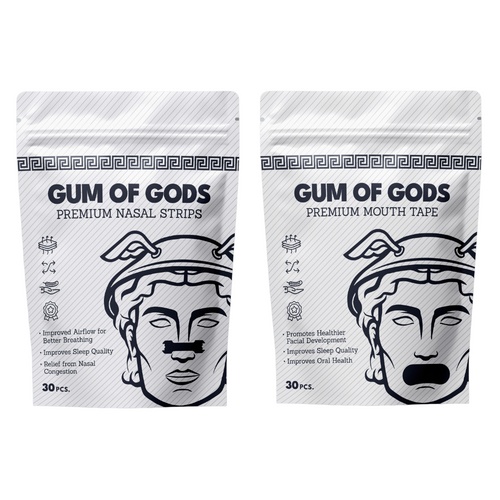
The protocol is twenty to forty minutes a day. That is roughly the time commitment of a warm-up. It can be done in the morning during email, during the commute, or during the rest of the workout itself. The Gum of Gods bundle that most regular users have settled on adds two pieces for the night: nasal strips and mouth tape, which together force nasal breathing during sleep. The combined effect addresses oral posture and airway alongside the daytime mechanical load — the recovery half of a complete training cycle.
Sixty thousand men currently subscribe to the protocol. The average rating is 4.7 stars. Visible jaw changes consistently appear in the 60–90 day window — the same timeline as any meaningful muscle development. Most users report noticing the difference around month two, with the most pronounced changes by month three. There is no shortcut. There is also, given the underlying biology, no real reason it shouldn't work.
The Aesthetic of Gods Bundle — 3-Month Protocol
The full 90-day training cycle for the masseter — authentic Chios mastiha plus the mouth tape and nasal strips that handle the recovery half. Long enough to see the visible adaptation. Covered by a 30-day money-back guarantee.
Why You're Only Hearing About It Now
The simplest explanation for why authentic Chios mastiha has not shown up in American supplement aisles is supply. The total annual global production of PDO-certified mastiha is roughly 150 metric tons — harvested by hand, from approximately 5,000 farming families on the island, using techniques that haven't meaningfully changed since antiquity. It is not a category any major American supplement company can enter at scale. There simply isn't enough of it to supply one.
What has begun to change that is a small number of direct-sourcing operations — one of which is a Florida-based brand called Gum of Gods. They source their mastiha directly from Chios producers, import the raw resin in small batches, and sell it in flavored variants engineered specifically for chewing rather than extract or capsule. The brand has quietly built a subscriber base that, by their numbers, now exceeds 60,000 men running the full protocol — most of whom, the data they shared with me suggested, are people who already train.
Their flagship configuration — what they call the Aesthetic of Gods Bundle — pairs the mastiha with mouth tape and nasal strips for the complete day-and-night protocol. The three-month subscription is the configuration most users start on, because the visible jaw changes consistently appear in the 60–90 day window. That is the same window any other muscle takes to show meaningful adaptation. There is no shortcut around it.
What 90 Days Actually Looks Like
A few things worth knowing before you order, based on the timeline that the trainers I spoke with — and the company's own data — consistently describe.
Weeks 1–2: the loading phase. The resin is hard. It sticks to teeth for the first minute or two before the temperature of the mouth softens it. Your jaw will be sore the next morning the way a new lifter's shoulders are sore after their first push day. This is not a malfunction. This is the muscle being loaded for the first time. By the end of the second week, the soreness has dropped off and 30 minutes of chewing has stopped feeling difficult.
Weeks 3–4: the breathing reset. The bundled mouth tape and nasal strips, which most men initially treat as throw-ins, turn out to do real work. Forced nasal breathing during sleep — well documented in the sleep literature — drives proper tongue posture, deeper sleep, and reduced morning facial puffiness. Most users report a meaningful drop in resting heart rate and a partner who notices, without prompting, that they have stopped snoring.
Weeks 6–8: the visible change. This is the window almost every regular user cites as the moment the lower face starts looking different in photographs. The masseter has begun to hypertrophy. Lower face appears leaner. The chin angle becomes more defined. Most men notice it themselves before others do.
Month 3 and beyond: the adapted state. By the end of the 90-day window, the visible change is fully expressed. The masseter has reached a measurable new baseline; the breathing protocol has fully reset oral posture; the lower face is structurally different from the starting point. The 30-day money-back guarantee on the Gum of Gods bundle exists because, by the company's own admission, the product needs the protocol window to deliver what it is marketed for.
The bundle matters. I asked several long-term users what they would tell someone considering the standalone resin versus the full bundle. The answer was unanimous. The resin alone trains the muscle during the day. The bundle handles the eight hours at night during which mouth breathing silently undoes the daytime work. For anyone who already trains hard, the bundle is the configuration that matches what the rest of the training is doing — both halves of the load-recovery cycle, not just half.
If you have spent years putting work into the rest of your physique, this is the protocol for the part that actually shows. There is no other piece of training that targets the masseter at any meaningful resistance load. There is, given the underlying biology, no real reason it shouldn't work.
Train the Part That Actually Shows
You've put the work in everywhere else. The 3-month bundle is the protocol for the part that actually shows. If it doesn't deliver, every dollar comes back.
See Availability →