




Chios Mastic Gum Benefits: What the Research Says
Mastic is the resin of the Pistacia lentiscus tree, and the mastic chewed for centuries around the Mediterranean comes from Chios, Greece. Scientists have studied it for decades.
Below, we walk through the main human studies on stomach bacteria, cholesterol, plus how the European Medicines Agency describes mastic's traditional use for mild indigestion, with links to every source so you can read them yourself. This is a summary of research, not medical advice.
Talk to your doctor before using mastic for any health condition.
New to mastic? Start with What Is Mastic Gum?.
At a glance
| Topic | What the sources say |
|---|---|
| H. pylori | Lab kill effect; mixed human trials |
| Cholesterol | Total cholesterol down in an 8 week pilot |
| Mild indigestion | Listed by the EMA as a traditional herbal use |
| Gum base | Regular gum base contains plastics |
What is Chios mastic gum?
Chios mastic gum is the natural resin that seeps from the bark of the mastic tree, Pistacia lentiscus, and hardens into tears. It is hand harvested on the Greek island of Chios and has been chewed for centuries. It is firm, piney in taste, and is chewed as is, with no synthetic gum base.
The studies below used measured doses of mastic, such as capsules or powder, or lab tests, not chewed gum, so the dose and format are noted for each one.
Does mastic gum affect H. pylori?
Studies found mastic had activity against H. pylori, the stomach bacterium linked to ulcers. A 1998 report in the New England Journal of Medicine was titled "Mastic Gum Kills Helicobacter pylori," and a 2010 randomized pilot from Chios found eradication in some patients. Results are mixed, so mastic is not a replacement for medical treatment.
Here is what the human research shows:
- 2010 randomized pilot (Dabos et al., Phytomedicine). Researchers at Chios General Hospital randomized 52 patients with confirmed H. pylori infection. H. pylori was eradicated in 4 of 13 patients taking 350 mg of mastic three times a day for 14 days, and in 5 of 13 taking 1.05 g three times a day. In the standard antibiotic triple therapy group, 10 of 13 cleared the infection. All patients tolerated mastic well, with no serious adverse events, and the authors concluded mastic gum has bactericidal activity on H. pylori in vivo.
- 2003 small study (Bebb et al., Journal of Antimicrobial Chemotherapy). Eight patients took 1 g of mastic four times a day for 14 days. All remained H. pylori positive on breath tests.
The honest summary: lab work and some patients responded, but standard medical therapy performed better in the head to head pilot. If you have a diagnosed infection, follow your doctor's plan.
Source: Dabos et al., Phytomedicine, 2010; Bebb et al., J Antimicrob Chemother, 2003; Huwez et al., N Engl J Med, 1998. Links in References.

Can mastic gum lower cholesterol?
In a pilot trial of adults with total cholesterol above 200 mg/dL (Kartalis et al., 2016), 1 g a day of crude mastic in capsules for eight weeks lowered total cholesterol by about 11.5 mg/dL (adjusted for age, sex and BMI; 13.5 mg/dL in participants with BMI over 25). Two other mastic groups (polymer-free and 2 g powder) showed no significant change.
Details from the study (Kartalis et al., European Journal of Preventive Cardiology):
- Who: 179 volunteers with total cholesterol above 200 mg/dl were randomized. 156 completed follow-up.
- Groups: placebo; 1 g a day of crude mastic in capsules; 1 g a day of polymer-free mastic; and 2 g a day of mastic powder.
- Findings: the 1 g crude mastic group lowered total cholesterol by 11.5 mg/dl and fasting glucose by 4.5 mg/dl. The polymer-free and powder groups showed no statistically significant change.
- What did not change: LDL, HDL, triglycerides, uric acid and CRP.
- Safety: no gastrointestinal, liver or kidney adverse events were recorded.
This study used capsules, not chewing gum, so it does not tell us what chewing a few pieces a day does.
Source: Kartalis et al., European Journal of Preventive Cardiology, 2016 (CHIOS-MASTIHA). Link in References.
Is mastic used for indigestion?
The European Medicines Agency (EMA) has published an EU herbal monograph on mastic resin. It lists mastic as a traditional herbal medicinal product for mild dyspeptic disorders, which means mild indigestion.
"Traditional" means the listing is based on long-standing use, not on clinical trials. If indigestion is frequent or severe, see a doctor rather than relying on mastic.
Source: European Medicines Agency, European Union herbal monograph on Pistacia lentiscus L., resin (mastic), EMA/HMPC/46758/2015. Link in References.
Is mastic gum safe to chew every day?
Studies above, which used capsules or powder, reported mastic was well tolerated. The H. pylori pilot reported no serious adverse events, and the cholesterol trial recorded no gastrointestinal, liver or kidney adverse events. Mastic is firm, so start with one or two pieces and stop if your jaw feels sore.
If you are pregnant, on medication or managing a condition, ask your doctor first. If you have jaw joint (TMJ) issues, keep sessions short.
For swallowing, allergy, medications and pregnancy in more detail, read Mastic Gum Side Effects: Is It Safe?
How is mastic different from regular gum?
Mastic is a single tree resin, chewed as is. Regular gum base contains plastics: US rules allow synthetic polymers such as polyvinyl acetate and polyethylene in gum base. Mastic also starts firmer, softens slowly and has a natural pine taste instead of added sweetness.
For the full comparison, read Mastic Gum vs Regular Gum. To make sure you are buying the real resin, see Real vs Fake Mastic Gum.

How should you start chewing mastic?
Start with one or two pieces for 10 to 20 minutes and see how it feels. Mastic begins hard and brittle, then softens into a chew. Pick a flavor you will actually enjoy daily, because consistency matters more than any single session.
Our guide Which Mastic Gum Flavor to Start With helps you choose. Many customers also chew for face muscle work, covered in Gum for Face Muscles.
Start here: every Gum of Gods guide
This page is our hub. Each topic below has its own deep dive with sources.
- Choosing a brand: Best mastic gum: how to choose real Chios resin compares formats and names names.
- What is in regular gum: Microplastics in chewing gum explains gum base polymers and the 2025 microplastics study.
- Face muscles: Gum for face muscles covers chew resistance and safe chewing time.
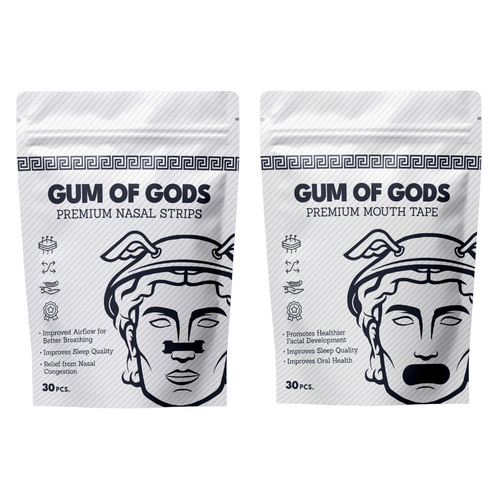
- Sleep and breathing: The sleep and breathing stack pairs a day chew with nasal strips and mouth tape.
How to chew mastic for daily use
Put one or two tears in your mouth and let them warm for 20 to 30 seconds. They will crumble at first, then come together into a firm chew. Start with 10 to 20 minutes and build up.
Most people chew 1 to 3 times a day. Mastic tastes like pine and fresh herbs, and the flavor fades into a neutral chew that lasts. Keep tins out of hot cars, because resin softens in heat.
If you have dental work or jaw pain, ask your dentist before chewing firm resin daily.
Where to start: The Classic Pack for pure resin, Peppermint for a sweeter chew, or Premium with pine pollen. Curious about the history of the island and the harvest? Read The Art of Mastiha.
The bottom line
None of these sources tested chewed gum: the human studies used measured doses of mastic, such as capsules or powder, and the 1998 report was lab work. None shows that chewing any gum treats a condition.
Human results on H. pylori are mixed, one pilot trial found a small drop in total cholesterol with mastic capsules, and the EMA lists mastic as a traditional herbal medicine for mild indigestion. The studies were small or pilot studies, and results are not always consistent. That is the honest picture, and it is why we link every source.
Ready to try real resin from Chios? Start with The Classic Pack.
FAQ
Does mastic gum affect H. pylori?
Studies found mastic had activity against H. pylori. In a 2010 randomized pilot from Chios, eradication occurred in 4 of 13 and 5 of 13 patients on two mastic doses. Results are mixed, so mastic is not a replacement for medical treatment.
Can mastic gum lower cholesterol?
In a pilot trial of adults with total cholesterol above 200 mg/dL, 1 g a day of mastic in capsules for eight weeks lowered total cholesterol by about 11.5 mg/dL; two other mastic groups showed no significant change. LDL, HDL and triglycerides did not change.
Is mastic used for indigestion?
The European Medicines Agency lists mastic resin as a traditional herbal medicinal product for mild indigestion (mild dyspeptic disorders), based on long-standing use rather than clinical trials.
Is mastic gum safe to chew every day?
The studies above, which used capsules or powder, reported mastic was well tolerated, with no serious adverse events in the H. pylori pilot and no gastrointestinal, liver or kidney events in the cholesterol trial. Start with one or two pieces and ask your doctor if you have a condition.
How is mastic different from regular gum?
Mastic is a single tree resin from Chios, chewed as is. Regular gum base contains plastics, since US rules allow synthetic polymers like polyvinyl acetate and polyethylene. Mastic is firmer and tastes of pine.
Your next steps
- Start with The Classic Pack.
- Try before committing with the Sample Pack.
- Compare all three flavors with the 3-Gum Bundle.
- Browse all mastic gum and bundles.
Keep reading
References
- Huwez FU et al. Mastic gum kills Helicobacter pylori. N Engl J Med, 1998;339:1946. doi:10.1056/NEJM199812243392618 https://pubmed.ncbi.nlm.nih.gov/9874617/
- Dabos KJ et al. The effect of mastic gum on Helicobacter pylori: a randomized pilot study. Phytomedicine, 2010. doi:10.1016/j.phymed.2009.09.010 https://pubmed.ncbi.nlm.nih.gov/19879118/
- Bebb JR et al. Mastic gum has no effect on Helicobacter pylori load in vivo. J Antimicrob Chemother, 2003. doi:10.1093/jac/dkg366 https://pubmed.ncbi.nlm.nih.gov/12888582/
- Kartalis A et al. Effects of Chios mastic gum on cholesterol and glucose levels of healthy volunteers (CHIOS-MASTIHA). Eur J Prev Cardiol, 2016. doi:10.1177/2047487315603186 https://pubmed.ncbi.nlm.nih.gov/26311707/
- US Code of Federal Regulations, 21 CFR 172.615, "Chewing gum base." https://www.law.cornell.edu/cfr/text/21/172.615
- European Medicines Agency, herbal monograph: European Union herbal monograph on Pistacia lentiscus L., resin (mastic), EMA/HMPC/46758/2015. https://www.ema.europa.eu/en/medicines/herbal/mastic