




Gum for Face Muscles: What Chewing Research Shows
Soft food and soft gum barely ask your face muscles to work. That is the problem a lot of people are trying to fix when they search for a harder chew. This guide frames chewing as face and jaw muscle training with chew resistance.
It covers what the research shows, what temporary jaw fatigue feels like and what to expect.
This is not medical advice. If you have jaw joint pain, dental work or a diagnosed TMJ disorder, talk to a dentist or clinician before you start a hard-chew habit.
At a glance
| Chew | Resistance |
|---|---|
| Soft supermarket gum | Low, softens in minutes |
| Chios mastic resin | Firm, holds 20 to 40 min |
| Silicone trainers | Very high, short sets |
Does chewing hard gum work your face muscles?
Yes. Chewing recruits the masseter and other masticatory muscles with every cycle, and harder boluses demand more work than soft gum. That is the training load. A 2024 randomized trial found daily gum chewing raised maximum bite force by three months, which is a strength signal, not a promise about face shape.
You feel it as burn and fatigue, the same way you feel a set of curls. That temporary fatigue is the main objection, and we cover it below.
What does the research say about bite force and the masseter?
A 2024 randomized trial in healthy adults found daily gum chewing raised maximum bite force by three months versus control. Masseter thickness and jaw shape did not change in that study.
Details worth knowing:
- Yonsei RCT, 2024 (Journal of Oral Rehabilitation, PMID 39215439). Fifty-eight healthy adults. Training group chewed gum three times a day for six months. Maximum occlusal force at three months was significantly higher than baseline and versus control (p < .001). Occlusal contact area rose with force. There was no statistically significant change in masseter muscle thickness or mandibular shape versus baseline. Honest takeaway: bite force can go up without a measured change in muscle thickness or jaw bone shape in that design.
- Prolonged chew lab work (Farella et al., 2001, PMID 11347660). Fifteen women without TMD chewed very hard gum, soft gum or empty chewed for 40 minutes. Pain and fatigue scores rose only with hard gum, then fell almost to baseline after about 10 minutes of recovery. Pressure pain thresholds did not change. The authors concluded jaw muscles recover quickly from prolonged chewing in people without TMD.
- Excessive chew model (2020, PMID 32600327). Forty or 60 minutes of chewing produced high subjective fatigue lasting up to about 20 minutes after. Mild pain appeared mainly in the 60-minute trial and did not last to the first 10-minute follow-up. The authors said this form of excessive chewing is not a proper experimental pain model for TMD, especially in women.
None of these papers tested Gum of Gods specifically. They support the idea that a harder, longer chew loads the masseter and can change bite-force measures. They do not prove a specific look.

How is mastic different as a training chew?
Chios mastic is a single tree resin. It starts firm, softens as it warms, and keeps resistance longer than soft supermarket gum. Regular gum base contains plastics under US rules (21 CFR 172.615). Mastic does not use that base.
Our Classic Pack is raw Chios resin, nothing added, about a 30-day tin when you use one to two pieces a day. Warm pieces 20 to 30 seconds before you chew so they soften instead of crumbling.
For how to pick a flavor, see Which Mastic Gum Flavor to Start With. For benefits beyond chew training, see Chios Mastic Gum Benefits.
Comparing mastic with a branded training gum? Our Jawliner vs mastic gum guide sets their ingredients, stated hardness and chew limits side by side.
Will chewing hard gum make my jaw sore?
Often yes at first, and that temporary fatigue is expected when you raise training load. In the 2001 hard-gum session, pain and fatigue rose during the chew and dropped nearly to baseline after about 10 minutes of rest in people without TMD.
If soreness lasts, gets sharper or includes joint clicking with pain, stop and get checked.
Responsible starting plan:
- Short sessions first. Ten to fifteen minutes, once a day, for the first week.
- One or two pieces. Do not stack a huge bolus on day one.
- Stop on sharp pain. Muscle burn that fades is different from joint pain.
- Rest days. Treat the masseter like any other muscle.
- Dental work caution. Crowns, veneers, fresh fillings and braces change the risk picture. Ask your dentist.

What about TMJ and chewing gum?
Evidence linking everyday gum chewing to chronic TMJ disorders is mixed. Experimental work shows short-lived fatigue after long, hard sessions in healthy people. Hard mastic is not a treatment for TMJ disorders, and it can aggravate an irritated joint.
If you already have TMJ pain, lockjaw, frequent headaches from the jaw, or a clinician told you to limit chewing, skip hard resin or get clearance first. Capsules exist for people who want mastic without the workout.

How does face-muscle chewing fit a full day and night routine?
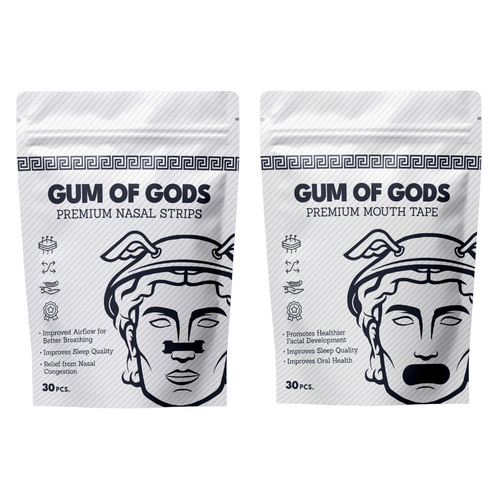
Daytime: a firm mastic session that works your face muscles. Nighttime: nasal strips and careful mouth taping for people who already breathe through the nose and want a nasal-breathing habit. That stack is covered in Sleep Breathing Stack. Do not use mouth tape if your nose is blocked.
A 4 week face muscle chewing routine
- Week 1: one 10 minute session a day. Chew on both sides evenly.
- Week 2: two sessions of 10 to 15 minutes.
- Week 3: two sessions of 15 to 20 minutes. Add a fresh tear halfway if the chew softens.
- Week 4: up to 30 to 40 minutes a day total, split into sessions.
Muscle tiredness that fades within a day is normal. Joint clicking with pain, locking or headaches are stop signs. Research on prolonged chewing shows fatigue and soreness rise with long, intense sessions, so more is not always better. Rest days are fine.
Why we chew resin
We like mastic for face muscle work because it is firm, long lasting and a single tree resin instead of a plastic gum base.
The best evidence so far shows chewing builds bite strength; the trial we cite did not measure a shape change.
If you also care about sleep, pair the day chew with our sleep and breathing stack.
The bottom line
Hard gum works your face muscles. A 2024 randomized trial found daily gum chewing raised maximum bite force by three months. Masseter thickness and jaw shape did not change in that trial. Start short, respect temporary fatigue, and protect the joint. Ready to try a lasting Chios resin chew?
Start with The Classic Pack.
FAQ
Does chewing hard gum work your face muscles?
Yes. Chewing recruits the masseter and other masticatory muscles with every cycle, and harder boluses demand more work than soft gum. A 2024 randomized trial found daily gum chewing raised maximum bite force by three months, which is a strength signal, not a promise about face shape.
What does the research say about bite force and the masseter?
A 2024 randomized trial in healthy adults found daily gum chewing raised maximum bite force by three months versus control. Masseter thickness and jaw shape did not change in that study.
How is mastic different as a training chew?
Chios mastic is a single tree resin. It starts firm, softens as it warms, and keeps resistance longer than soft supermarket gum. Regular gum base contains plastics under US rules. Mastic does not use that base.
Will chewing hard gum make my jaw sore?
Often yes at first. Temporary fatigue is expected when you raise training load. In a 2001 hard-gum session, pain and fatigue rose during the chew and dropped nearly to baseline after about 10 minutes of rest in people without TMD. Stop if soreness is sharp or lasting.
What about TMJ and chewing gum?
Evidence linking everyday gum chewing to chronic TMJ disorders is mixed. Hard mastic is not a treatment for TMJ disorders and can aggravate an irritated joint. If you have jaw joint pain, get clearance before a hard-chew habit.
Your next steps
- Start the routine with The Classic Pack.
- Test first with the Sample Pack.
- Browse all mastic gum and bundles.
Keep reading
References
- Jung HJ et al. Effects of gum chewing training on occlusal force, masseter muscle thickness and mandibular shape: a randomised controlled clinical trial. J Oral Rehabil, 2024. doi:10.1111/joor.13830 https://pubmed.ncbi.nlm.nih.gov/39215439/
- Farella M et al. Effects of prolonged gum chewing on pain and fatigue in human jaw muscles. Eur J Oral Sci, 2001. doi:10.1034/j.1600-0722.2001.00991.x https://pubmed.ncbi.nlm.nih.gov/11347660/
- Experimental pain and fatigue induced by excessive chewing. BMC Oral Health, 2020. doi:10.1186/s12903-020-01161-z https://pubmed.ncbi.nlm.nih.gov/32600327/
- US Code of Federal Regulations, 21 CFR 172.615, "Chewing gum base." https://www.law.cornell.edu/cfr/text/21/172.615
- European Medicines Agency, herbal monograph: Mastic (Pistacia lentiscus L., resin). https://www.ema.europa.eu/en/medicines/herbal/mastic